BE PREPARED

ESSENTIALS:

BOOKMARK THIS PAGE INCASE YOU NEED IT LATER!

DOING CPR

Free Online CPR and First Aid Training Course

Visual Guides:
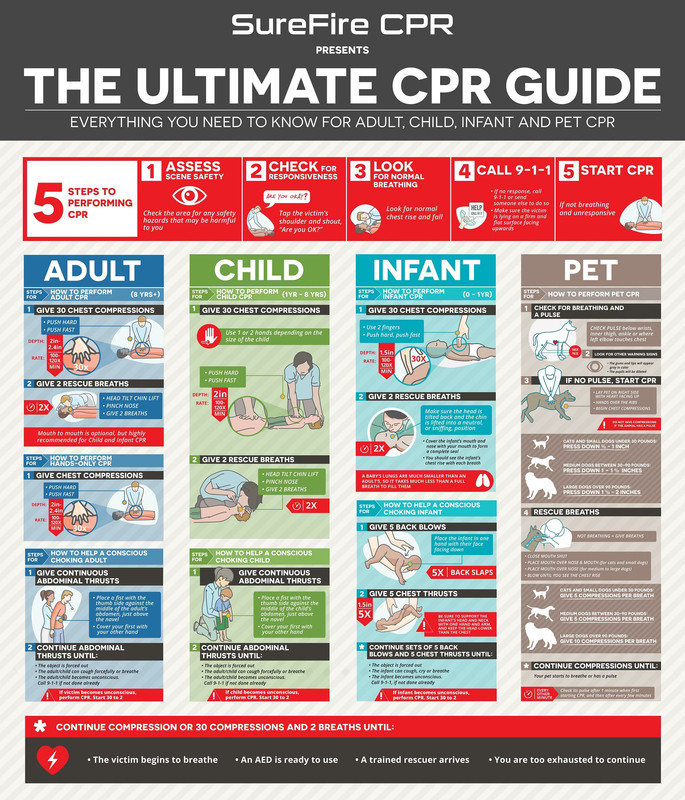
Everything You Need to Know for Adult, Child, Infant and Pet CPR
5 Steps to Performing CPR:

Assess Scene Safety

Check the area for any saftey hazards that may be harmful to you.
Check for Responsiveness
Tap the victim’s shoulder and shout, “Are you OK”
Look for Normal Breathing
Call 9-1-1
If no response, call 9-1-1 or send someone else to do so
Make sure the victim is lying on a firm and flat surface facing upwards
Start CPR

If not breathing and unresponsive

Steps for How to Perform Adult CPR:

Give 30 Chest Compressions
Push down hard and fast in the middle of the chest, over the breastbone, with one hand on top of the other and fingers interlaced
Press down 2-2.4 inches deep and at least 100-120 compressions per minute
Allow for full chest recoil between each compression
Give 2 Rescue Breaths
Make sure the head is tilted back and the chin is lifted
Pinch the nose shut and cover the victim’s mouth with your mouth to form a complete seal
Blow inside the victim’s mouth for 1 second and check to see if the victim’s chest rises
If their chest does not rise, give another breath
Mouth to mouth is optional, but highly recommended for child and infant CPR
Continue 30 Compressions And 2 Breaths Until
The victim begins to breathe
An AED is ready to use
A trained rescuer arrives
You are too exhausted to continue
Special Considerations for Adult CPR

Depending on the age of the Adult victim, the rescuer may fracture the sternum and/or ribs of the victim when performing CPR
In order for CPR to be effective, the rescuer must push down hard, at least 2 inches deep, on the victim’s chest. Although, this pressure may do harm to the victim such as break bones. The decision to give CPR relies on the rescuer, but physicians suggest that the victim would most likely rather live with broken bones than not live at all

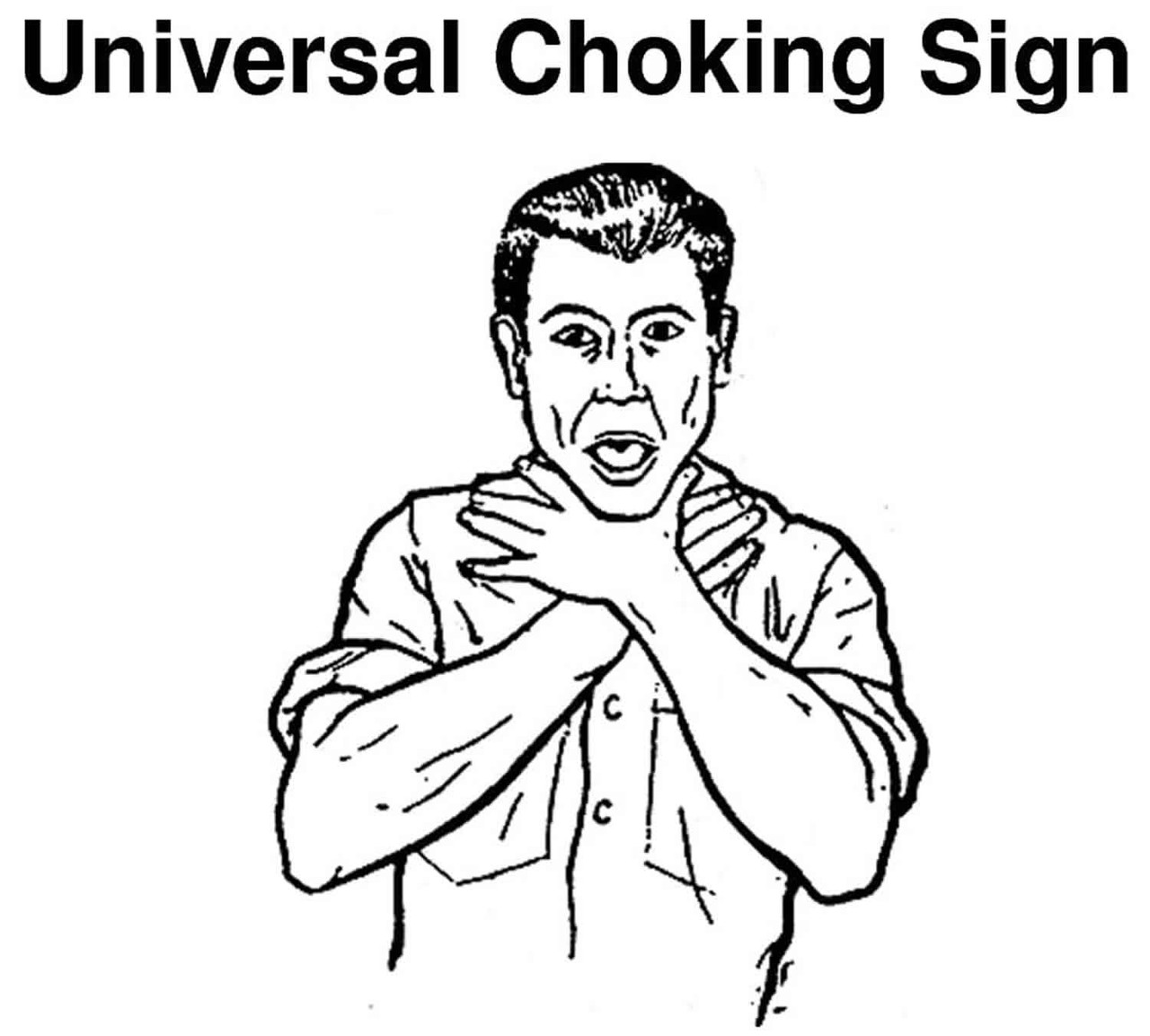
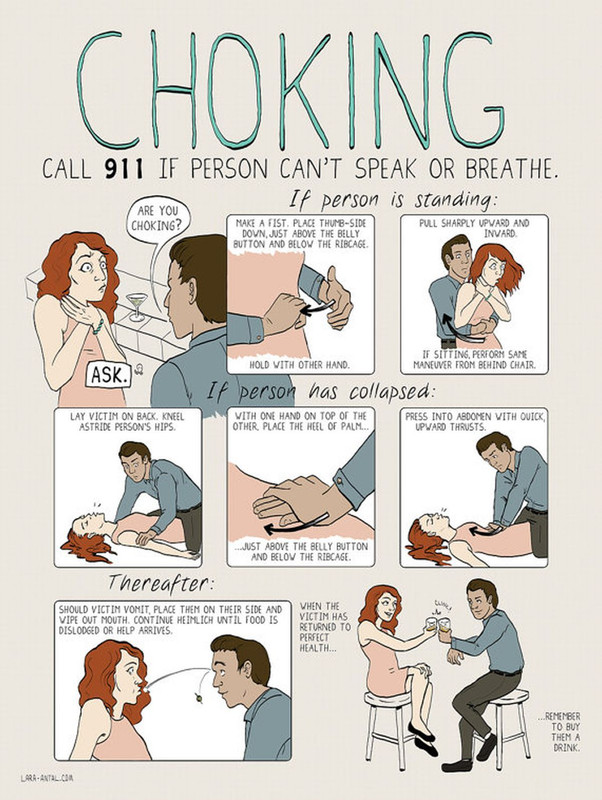
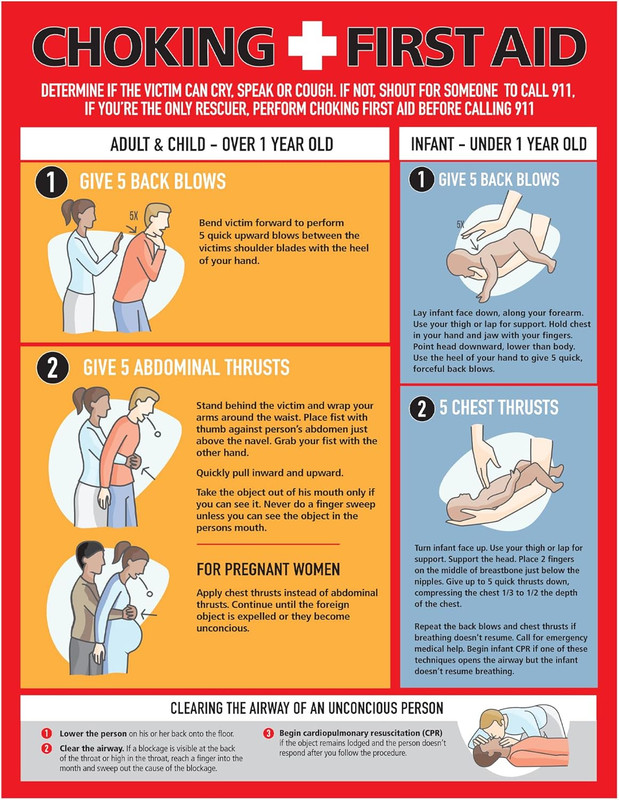
Steps for How to Help a Conscious Choking Adult:

Give Continuous Abdominal Thrusts
Place a fist with the thumb side against the middle of the child’s abdomen, just above the navel
Cover your fist with your other hand
Continue Abdominal Thrusts Until
The object is forced out
The adult/child can cough forcefully or breather
The child becomes unconscious. Call 9-1-1 if not done already

Steps For How to Perform Child CPR (1yr-8yr):

Give 30 Chest Compressions

You can use one or two hands: For one-handed compressions, press down hard and fast on the center of the chest using the heel of your hand
For two-handed compressions, push down hard and fast on the center of the chest with the heel of one hand and place the other over top
Push down about 2 inches deep, giving at least 100 compressions per minute
Allow for full chest recoil between each compression

Give 2 Rescue Breaths

Make sure the head is tilted back and the chin is lifted
Pinch the nose closed and cover their mouth with your mouth to form a complete seal
Blow inside the victim’s mouth for 1 second and look for their chest to rise
If the chest doesn’t rise, give another breath

Steps on How to Help A Conscious Choking Child:

Give Continuous Abdominal Thrusts
Place a fist with the thumb side against the middle of the child’s abdomen, just above the navel
Cover your fist with your other hand
Continue Abdominal Thrusts Until
The object is forced out
The adult/child can cough forcefully or breather
The child becomes unconscious. Call 9-1-1 if not done already

If child becomes unconscious, perform CPR. Start 30 to 2
Steps for How to Perform Infant CPR:

Give 30 Chest Compressions

Using two fingers, push down in the center of the chest, just below the nipple line
Give 30 chest compressions at the rate of at least 100 per minute
Press down approximately 1 1/2 inches deep
Allow for full chest recoil between each compression

Give 2 Rescue Breaths

Make sure the head is tilted back and the chin is lifted into a neutral, or sniffing, position
Cover the infant’s mouth and nose with your mouth to form a complete seal
Give 2 rescue breaths, each 1 second long
You should see the infant’s chest rise with each breath
**A baby’s lungs are much smaller than an adult’s, so it takes much less than a full breath to fill them

Steps for How to Help a Conscious Choking Infant:

** The infant cannot cough, cry or breathe**

Give 5 Back Blows

Place the infant in one hand with their face facing down
Give 5 firm back blows with the heel of one hand between the infant’s shoulder blades
Give 5 Chest Thrusts
Turn the infant over so their face is upwards in one arm with the same hand cupping their head
Place two or three fingers in the center of the infant’s chest just below the nipples and press down onto the breastbone, about 1 1/2 inches deep – 5 Compressions
**Be sure to support the infant’s head and neck with one hand and arm, and keep the head lower than the chest**
Continue Sets of 5 Back Blows And 5 Chest Thrusts Until:
The object is forced out
The infant can cough, cry or breathe
The infant becomes unconscious. Call 9-11, if not done already

Steps For How to Perform Pet CPR:

Check For Breathing And a Pulse

Using your middle and index fingers, check your pet’s pulse below its wrist, inner thigh, below the ankle, or where the left elbow touches the chest
Check pulse below wrists, inner thight, ankle or where left elbow touches chest

Look For Other Warning Signs

The gums and lips will appear gray in color
The pupils will be dilated

If No Pulse, Start CPR

Lay your pet on its right side, with its heart facing upwards
Place your hands over the ribs where its elbows touches the chest
Begin chest compressions (**DO NOT give compressions if the animal has a pulse)

Cats and small dogs under 30 pounds: press down ½ – 1 inch
Medium dogs between 30-90 pounds: press down 1 – 1 ½ inches
Large dogs over 90 pounds: press down 1 ½ – 2 inches

Rescue Breaths

If your pet is not breathing, give rescue breaths
Cats and small dogs: close your pets mouth shut, place your mouth over the nose and mouth, and blow until you see chest rise
Medium to large dogs: close your pets mouth shut, place your mouth over the nose, blow until you see chest rise

Cats and small dogs under 30 pounds: give 5 compressions per breath
Medium dogs between 30-90 pounds: give 5 compressions per breath
Large dogs over 90 pounds: give 10 compressions per breath

5. Continue Compressions And Breaths Until

Your pet starts to breathe or has a pulse
**Check its pulse after 1 minute when first starting CPR, and then after every few minutes

USING NARCAN

Free Online Narcan Training Courses

Visual Guides:
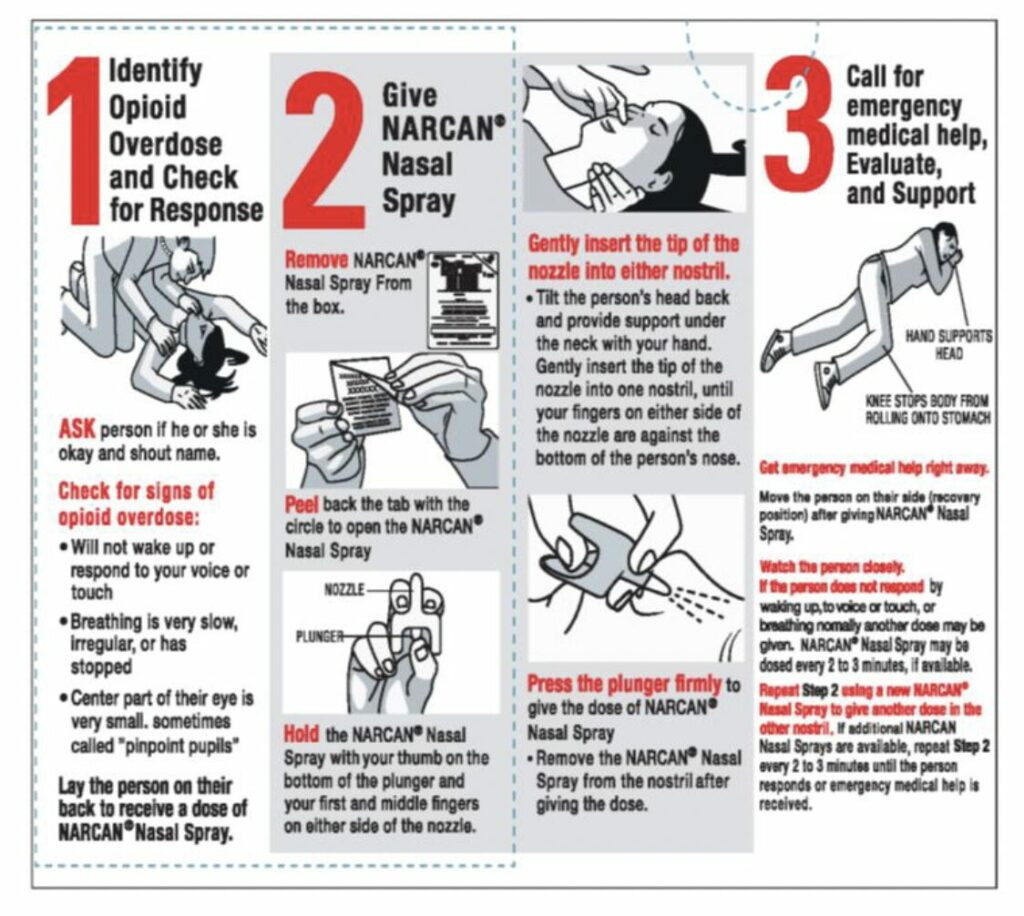
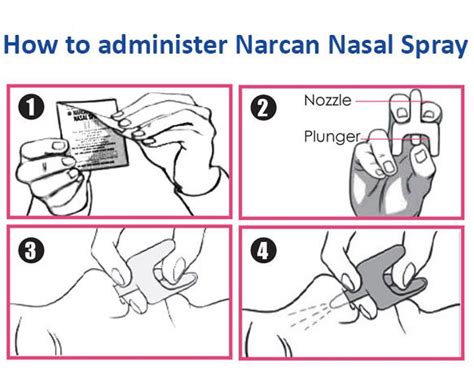
4 panels with the above caption how to administer narcan nasal spray panel 1 has hands peeling open the package from the back panel 2 shows a hand positioned with its index and middle finger sandwhiching the nozzle and the thumb placed under the plunger panel 3 has the same hand holding the narcan nozzle up an unconscious persons nostril and panel 4 simply has an xray shot of the narcan getting sprayed into the nasal cavity